Selling Well, But Can’t Keep Up With Orders? Here’s What To Do
Have you ever wondered how top-selling stores with huge order volumes manage to deliver to every customer without mistakes or missed items? Of course, when humans handle everything manually, errors are bound to happen — whether from forgetfulness or miscommunication. Today, I’ll share the techniques most organizations use to solve the problem of unmanageable order volumes.
What Is Order Management?
Order Management is the process of managing product and service orders, covering every step from the moment a customer places an order to the final step of delivery. It’s a complex process because each stage has its own details and challenges, and workflows can differ from one organization to another. The order management process consists of 3 main steps:
1. Placement
2. Fulfillment
3. Inventory Management

When running a business, most operators run into a number of problems — missed orders, inaccurate stock or inventory data, or shipping the wrong item to a customer. These may not seem like serious issues, but they can frustrate customers and damage a company’s reputation. To reduce these order management problems, systems were created to make the work easier and reduce errors — one of which is the Order Management System, which many of you may have already heard of.
What Is an Order Management System?
An Order Management System (OMS) is a software system that helps manage sales and orders, letting you track every order efficiently within a single system. It works by taking in each order as it’s placed, then grouping orders by customer and priority, allocating stock across warehouses, and setting delivery dates based on agreed terms.
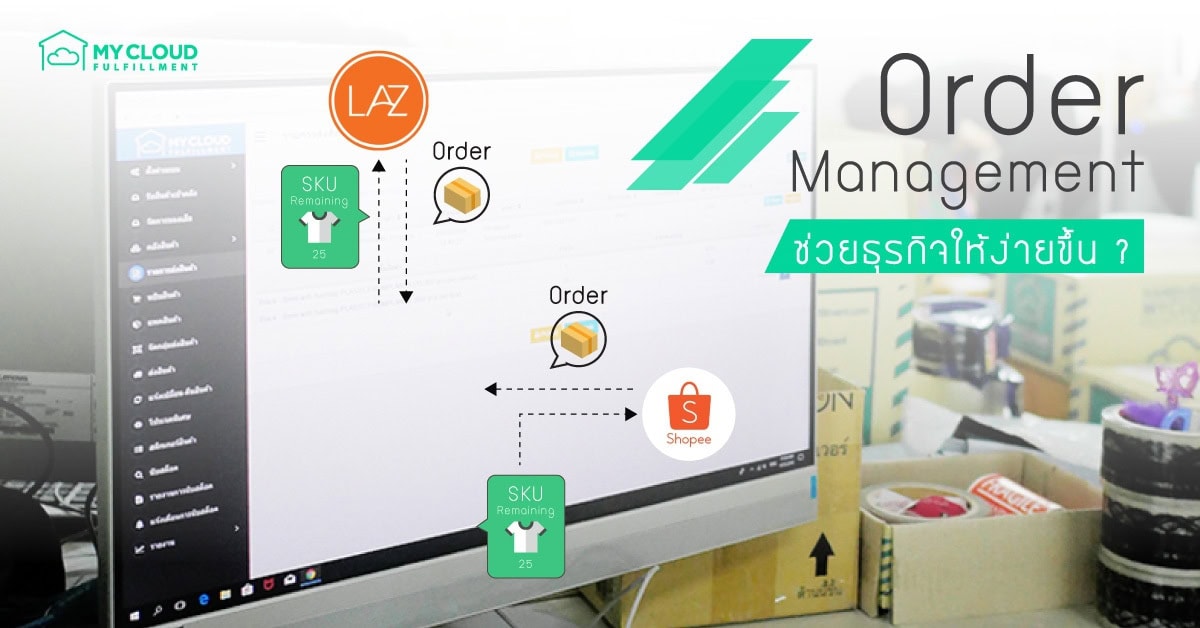
Today, an OMS can connect with APIs, letting you receive orders from multiple channels — whether entered manually or pulled automatically from marketplace APIs such as Lazada, Shopee, or other online channels where you sell. It also supports numerous payment methods, making things more convenient for buyers. For businesses without their own system or website, ready-made OMS platforms are available to help manage orders. And if you need help with stock storage, order picking, packing, and shipping, a good fulfillment service can meet those needs too — since that’s the core purpose fulfillment providers serve today.

Benefits of an Order Management System (OMS)
An effective order management system makes it easier to handle orders and every step of the sales process — which benefits business owners and everyone involved. By storing all customer and order data in a single database, businesses can analyze data thoroughly, completely, and accurately, which greatly improves inventory management, sales, and marketing. It also improves how efficiently the website itself runs, such as database management and site structure improvements. Because the system logs order data and lets you pull up customer order history, business owners gain a deeper understanding of their customers — making it easy to analyze customer behavior and interests in order to meet their needs more precisely. All of this helps business owners make better decisions and ensures customers get a great buying experience, which builds a strong impression and leads to brand loyalty. Using an order management system helps ensure your business’s sales operations run efficiently and smoothly.
Besides OMS being essential to order management, it also connects with a TMS (Transportation Management System).
Transportation Management System (TMS)
A TMS is a transportation management system that helps manage shipping efficiently and reliably. It covers everything from receiving orders, scheduling shipments, and sending details to drivers — and both the company and customers can track shipment status in real time, from origin to destination, with efficient GPS integration. It covers both domestic and international shipping, all product categories, and every shipping method — truck, air, or sea — and can work alongside other systems such as barcode systems or RFID.

Benefits of a Transportation Management System (TMS)
Besides reducing the complexity of managing shipping, a TMS also saves time and cuts costs by streamlining workflows. The system stores data that can be pulled up anytime — such as customer data, product data, shipping routes, staff data, or vehicle data — reducing both cost and time. It also means the company no longer has to manually manage vehicles, personnel, and paperwork. On top of that, a TMS schedules shipments efficiently, and because every step is logged, errors are far less likely — and if something does go wrong, there’s always a record to check.
As you can see, a TMS saves time and cost and produces far fewer errors than manual, paper-based systems. Choosing the right shipping system for your business size is just as important as any other business decision.
Running a business doesn’t have to be hard. Let us handle your business needs with back-office support — including the hassle of order management. MyCloud Fulfillment manages orders through MyCloud’s order management system, which connects to marketplace APIs or your own website, consolidating every order from every channel into a single system — whether Lazada, Shopee, JD.com, and more. We sync stock in real time across every marketplace, and also integrate with Seller Center to automatically mark orders as “Ready to Ship.” Rest assured you’ll never miss an important order — and you’ll increase your sales opportunities too. On top of that, we offer full storage, packing, and shipping services to keep your business running without a hitch!
Interested in learning more or signing up? Visit www.mycloudfulfillment.com
Or contact us for more information
Call: 092-472-7742, 02-138-9920
Email: [email protected]
Line: @mycloudgroup
MyCloudFulfillment — Sell with ease, no inventory handling needed
Full-service online warehousing: store, pack, and ship
Frequently Asked Questions About Back-Office Management Systems
Order Management is the process of managing product and service orders, covering every step from the moment a customer places an order to the final step of delivery.
There are 3 main steps: Placement, Fulfillment, and Inventory Management.
It starts when different types of orders are entered. The system groups orders by customer and priority, allocates stock across warehouses, and sets delivery dates based on agreed terms. It can also connect via API to receive orders from multiple channels, such as Lazada and Shopee.
A TMS is a transportation management system that helps manage shipping efficiently, covering everything from receiving orders and scheduling shipments to sending details to drivers and tracking shipment status in real time.
It covers both domestic and international shipping, all product categories, and every shipping method — truck, air, or sea — and can work alongside other systems such as barcode or RFID systems.
Besides reducing the complexity of managing shipping, a TMS also saves time and cuts costs by streamlining workflows.